Stick to the Facts
Add Nbsla.ca as a Preferred Source on Google to see more of our stories in your search results.

For months, Florida drivers, lawmakers, and law enforcement agencies have been locked in confusion over a new license plate law that appeared to criminalize something as ordinary as a dealership-issued plate frame. What began as a targeted attempt to crack down on license plate obscuring devices quickly turned into a statewide debate about overreach, unclear wording, and the risk of severe penalties for everyday motorists.
That uncertainty has now been addressed. After legislative revisions and official clarification, Florida has finally settled the issue through Senate Bill 488, signed into law by Governor Ron DeSantis. The updated law narrows its scope, clarifies what is and is not allowed, and attempts to align statutory language with enforcement guidance already issued by the state’s transportation authorities.
The result is a more precise but still strict legal framework governing how license plates can be displayed on vehicles across Florida.
The Origin of the Controversy: House Bill 253
A Law Intended to Stop Plate Obstruction Devices
The confusion traces back to House Bill 253, passed in October. The bill was originally designed to target a specific problem: devices and materials used to intentionally obscure or alter license plates to avoid identification by law enforcement and traffic cameras.
These include:
- Plate covers designed to block camera visibility
- Sprays and coatings meant to distort reflective surfaces
- Mechanical flippers or obscuring devices
- Any modification that interferes with readability
On paper, the intent was straightforward: prevent intentional evasion of identification.
A Problem in the Wording
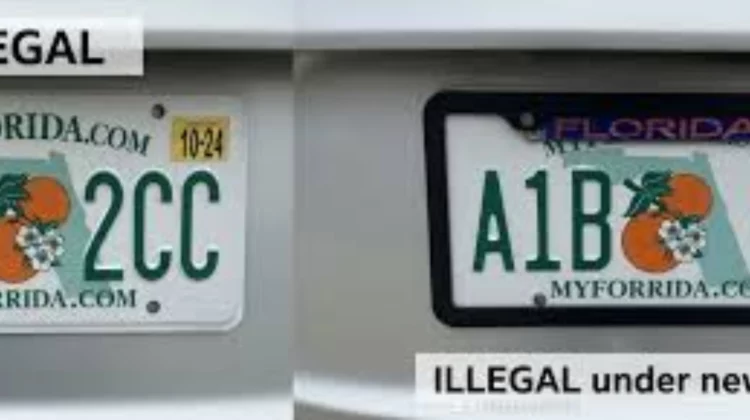
However, the bill’s language was broad enough that it extended beyond bad actors. The wording did not clearly distinguish between illegal obstruction devices and common accessories like dealership-installed plate frames.
As a result, drivers began to worry that even a standard frame that slightly covered the edge of a plate could result in violations. In some interpretations, even partially covering the state name or registration sticker could be considered illegal obstruction.
This ambiguity created widespread concern that ordinary drivers could face:
- Up to $500 in fines
- Possible misdemeanor charges
- Up to 60 days in jail in certain cases
The enforcement uncertainty quickly became a political issue.
Everyday Drivers Caught in Legal Gray Areas
Routine Plate Frames Suddenly Questioned
One of the most controversial aspects of the original interpretation was its impact on common license plate frames. These frames are often installed by dealerships or added by owners for aesthetic purposes.
Under strict readings of HB 253, even a frame that:
- Slightly covers the word “Florida”
- Touches the registration sticker edges
- Adds decorative borders around the plate
could potentially be considered illegal obstruction.
This led to confusion among drivers who had no intention of violating any law.
Fear of Harsh Penalties
The penalties outlined in the original framework added to the alarm. Depending on circumstances, violations could include:
- $500 fines for obstruction
- Misdemeanor charges for altering or defacing plates
- Increased penalties for criminal intent or repeat violations
- Felony charges if fake or altered plates were used during crimes
For many residents, the concern was not just the fine but the possibility of jail time for what appeared to be a minor equipment issue.
Senate Bill 488: The Law Rewritten for Clarity
What the New Law Changes
In response to public criticism and enforcement confusion, lawmakers passed Senate Bill 488, which redefines how license plate frames and coverings are treated under Florida law.
The updated law makes a key distinction:
License plate frames are legal as long as they do not obscure critical information.
That includes:
- License plate numbers
- Letters
- Registration details
- Validation stickers
If these elements remain fully visible and readable, a standard frame is permitted.
Aligning Law with Enforcement Guidance
The new statute also formalizes guidance already issued by the Florida Department of Highway Safety and Motor Vehicles. That guidance had previously indicated that normal frames were acceptable as long as they did not interfere with plate legibility.
By embedding this clarification into law, SB 488 eliminates the gap between written statute and real-world enforcement practice.
What Remains Illegal Under Florida’s Updated License Plate Rules
Despite the clarification, Florida’s law remains strict when it comes to intentional concealment or tampering.
Drivers are still prohibited from:
Altering or Defacing Plates
This includes:
- Changing plate colors
- Physically modifying numbers or letters
- Damaging plate surfaces to obscure readability
Using Obstruction Materials
Illegal materials and devices include:
- Reflective sprays or coatings
- Plastic or tinted covers that reduce visibility
- Electronic or mechanical devices designed to hide plates
- Any substance that reduces camera or human readability
Interfering With Visibility or Detection
Even indirect interference is prohibited if it affects:
- Angular visibility of the plate
- Ability to read information from a distance
- Capture by traffic enforcement systems
The core principle remains unchanged: license plates must always be clearly readable.
Penalties Under the Updated Law
Standard Violations
For non-criminal violations, penalties include:
- Fines up to $500
- Second-degree misdemeanor charges in some cases
- Vehicle equipment enforcement actions
Criminal Intent or Fraud Cases
The law escalates significantly when obstruction is tied to criminal activity.
If a driver uses a concealed or fake plate:
- Fines can reach $5,000
- Jail sentences can extend up to five years
- Charges may rise to felony level
These harsher penalties are aimed at preventing identity concealment during crimes such as theft, evasion, or fraud.
Public Reaction: Relief Mixed With Frustration
Concerns About Government Overreach
When HB 253 was first interpreted broadly, public reaction online was sharply critical. Many drivers argued that the law went too far in criminalizing everyday behavior.
Common criticisms included:
- Fear that minor accessories could lead to jail time
- Concerns about inconsistent enforcement
- Accusations that the law prioritized technical violations over serious crime
Some residents described the original interpretation as disproportionate to its purpose.
Support for Strong Enforcement
On the other hand, supporters of stricter enforcement argue that plate visibility is essential for:
- Crime prevention
- Toll and traffic enforcement
- Automated identification systems
- Public safety investigations
From this perspective, even small obstructions can create loopholes that criminals exploit.
Why License Plate Visibility Matters
Law Enforcement Dependence on Plate Data
Modern policing relies heavily on license plate recognition technology. Cameras across highways, toll roads, and intersections automatically record plate information.
If plates are obscured, even partially, it can:
- Disrupt investigations
- Delay suspect identification
- Reduce effectiveness of traffic enforcement systems
Balancing Convenience and Security
The challenge for lawmakers is balancing:
- Everyday vehicle customization
- Administrative clarity for drivers
- The need for reliable identification systems
Florida’s updated law attempts to strike that balance by allowing frames but strictly prohibiting anything that interferes with visibility.
How Florida Compares to Other States
Florida is not alone in regulating license plate visibility. Many states enforce similar rules, though with varying strictness.
Common approaches across the United States include:
- Banning tinted or reflective covers
- Requiring full visibility of plate numbers and stickers
- Penalizing intentional obstruction more severely than accidental interference
What made Florida’s situation unique was the initial ambiguity in HB 253, which temporarily expanded enforcement uncertainty beyond typical national standards.
Practical Guidance for Florida Drivers
To comply with the updated law, drivers should ensure:
- All plate characters are fully visible at all times
- Frames do not cover any part of numbers, letters, or stickers
- No coatings or sprays are applied to the plate surface
- Accessories do not interfere with camera readability
A simple rule applies: if anything blocks or distorts the plate in any way, it may be considered illegal.
Conclusion: A Law Finally Brought Into Focus
After months of confusion, Florida’s license plate law has finally been clarified. What began as a narrowly targeted anti-obstruction measure evolved into a statewide debate over legality, enforcement, and fairness. With the passage of Senate Bill 488 and its signing into law by Governor Ron DeSantis, lawmakers have now drawn a clearer boundary between legitimate vehicle accessories and illegal concealment devices.
For drivers, the outcome is simpler but still strict: license plate frames are allowed, but only if they do not obscure any critical information. The law continues to impose significant penalties for intentional obstruction, especially when tied to criminal activity, but removes the uncertainty that previously put ordinary motorists at risk of harsh punishment.