Stick to the Facts
Add Nbsla.ca as a Preferred Source on Google to see more of our stories in your search results.

A total solar eclipse is one of the rarest and most breathtaking events humans can witness, but scientists now say the age of the total solar eclipse will not last forever. The Moon is slowly moving away from Earth every single year, and that tiny shift is changing the future of every eclipse solar event our planet will ever see.
According to decades of lunar laser measurements, the Moon is drifting away from Earth at a rate of 3.8 centimetres per year. That number may sound tiny, but over millions of years it changes everything about the geometry of the Earth-Moon system. Eventually, the Moon will appear too small in the sky to completely block the Sun, meaning the total solar eclipse phenomenon humans enjoy today will vanish forever.
The incredible truth is that modern civilization exists during a perfect cosmic moment. Humans are alive during the exact era when the Moon and Sun appear almost exactly the same size in the sky. That extraordinary balance allows a total solar eclipse to happen. Future civilizations may never witness the kind of eclipse solar event people experience today.
Why a Total Solar Eclipse Happens
A total solar eclipse occurs when the Moon passes directly between Earth and the Sun and completely covers the Sun’s bright surface. During totality, the sky darkens, stars become visible, and the Sun’s outer atmosphere called the corona glows around the Moon.
The reason this happens is an extraordinary coincidence.
The Sun is about 400 times larger than the Moon, but it is also roughly 400 times farther away from Earth. Those ratios almost perfectly cancel out. From Earth’s surface, both objects appear nearly the same size in the sky.
That perfect alignment is what creates the dramatic eclipse solar experience millions travel across the world to see.
Without that balance, there would be no true total solar eclipse.
The Moon Is Slowly Escaping Earth
Scientists confirmed the Moon is moving away from Earth through one of the most accurate experiments in modern astronomy.
During the historic Apollo 11 Moon Landing mission in 1969, astronauts Neil Armstrong and Buzz Aldrin placed special mirror devices called retroreflectors on the Moon’s surface in the Sea of Tranquility.
Since then, observatories on Earth have fired laser beams at those reflectors for more than 50 years. Scientists measure the exact time it takes for the laser light to travel to the Moon and back.
The result is astonishingly precise.
Those measurements show the Moon is receding from Earth at 3.8 centimetres every year.
That slow movement is caused by tidal friction between Earth and the Moon. The Moon’s gravity pulls on Earth’s oceans, creating tides. As Earth rotates, those tidal bulges shift slightly ahead of the Moon’s position. The gravitational interaction transfers energy from Earth to the Moon, pushing the Moon outward into a wider orbit.
At the same time, Earth’s rotation is slowing down. Days are becoming slightly longer over enormous spans of time.
Why Future Humans May Never See a Total Solar Eclipse
Right now, the Moon sits at an average distance of about 384,400 kilometres from Earth. At that distance, the Moon can still completely cover the Sun during certain eclipse solar alignments.
But as the Moon keeps drifting away, it will eventually appear smaller in Earth’s sky.
When that happens, the Moon will no longer fully cover the Sun.
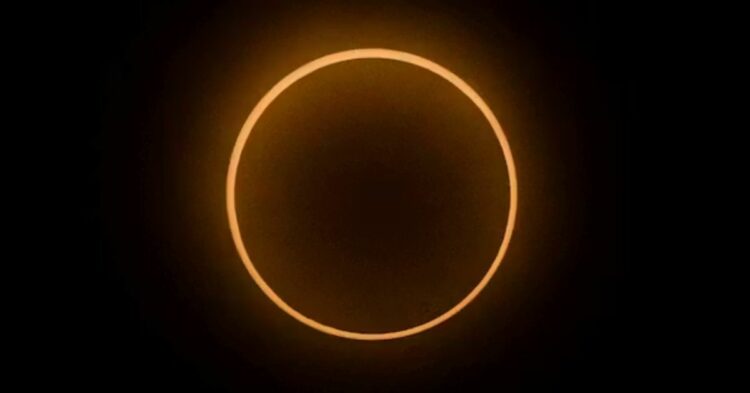
Instead of a total solar eclipse, future generations will only see annular eclipses, where a bright ring of sunlight remains visible around the Moon. These are often called “ring of fire” eclipses.
The dramatic darkness of totality will disappear forever.
Scientists estimate this transformation will happen hundreds of millions of years from now, but in cosmic terms, that is surprisingly soon.
The total solar eclipse era is temporary.
Earth Is the Only Known Planet With This Eclipse Solar Geometry
One reason astronomers find the eclipse solar phenomenon so fascinating is because Earth appears unique in the solar system.
No other known planet has a moon perfectly sized and positioned to create total eclipses like Earth’s.
Mars has two tiny moons, Phobos and Deimos, but they are far too small to completely cover the Sun. Jupiter’s giant moons appear much larger relative to the Sun from Jupiter’s orbit.
Only Earth has the rare geometry where the Moon and Sun appear almost identical in size from the surface.
That makes every total solar eclipse an incredibly rare cosmic event.
The Early Moon Looked Completely Different
Scientists believe the Moon formed around 4.5 billion years ago after a massive collision between early Earth and a Mars-sized object.
Back then, the Moon orbited much closer to Earth than it does today.
The early Moon may have been only 20,000 to 30,000 kilometres away. It would have looked enormous in the sky, many times larger than the Sun.
Ancient eclipse solar events during that era would not have resembled the total solar eclipse people see today. The Moon would have swallowed the Sun with ease.
Ironically, the precise balance modern humans enjoy did not exist for most of Earth’s history.
The perfect total solar eclipse became possible only after billions of years of lunar recession gradually moved the Moon into its current position.
Scientists Measure the Moon’s Movement With Lasers
The Lunar Laser Ranging Experiment remains one of the greatest long-term scientific experiments ever conducted.
Observatories such as Apache Point in New Mexico and research facilities in France continue firing lasers at Apollo-era reflectors and Soviet Lunokhod mission reflectors on the Moon.
The timing accuracy reaches astonishing levels, measured in picoseconds and millimetres.
Because of this precision, scientists know the Moon’s recession rate with extraordinary confidence.
Unlike many astronomy estimates that rely heavily on theoretical models, the Moon’s outward movement is directly measured.
That makes the future disappearance of the total solar eclipse one of the most scientifically reliable long-term predictions in astronomy.
Why Humans Are Living in a Special Cosmic Era
The realization that total solar eclipses are temporary changes how many people think about humanity’s place in time.
Human civilization exists during a narrow window when the Moon appears almost perfectly sized to cover the Sun.
Too early in Earth’s history, the Moon looked far too large.
Too late in Earth’s future, the Moon will look too small.
Right now is the perfect middle ground.
That means every total solar eclipse visible today is part of a limited chapter in Earth’s story.
Millions of years from now, people may study historical records showing skies suddenly turning dark during the daytime and struggle to fully understand what ancient humans witnessed.
Total Solar Eclipse Events Continue to Fascinate the World
Even with modern scientific explanations, a total solar eclipse still feels deeply emotional and almost supernatural to observers.
Crowds travel thousands of kilometres to stand inside the narrow path of totality. Temperatures drop, birds fall silent, and daylight transforms into twilight within minutes.
For many skywatchers, seeing a total solar eclipse becomes a once-in-a-lifetime experience.
Now scientists say those experiences are even more precious than people realized.
The eclipse solar phenomenon is not permanent. It is a temporary cosmic coincidence unfolding during humanity’s era on Earth.
Every total solar eclipse humans witness today represents a fleeting alignment between Earth, the Moon, and the Sun that future civilizations may never see again.