Stick to the Facts
Add Nbsla.ca as a Preferred Source on Google to see more of our stories in your search results.

Tensions between Canada and the United States have once again flared after U.S. President Donald Trump revived his controversial “51st state” rhetoric following reports that Canada has entered a technical recession. The comments immediately triggered a strong response from Ontario Premier Doug Ford, who rejected the idea outright and reaffirmed Canada’s sovereignty.
Ford’s remarks came as part of a broader wave of political reactions in Canada, including cautious responses from Prime Minister Mark Carney and growing concern over economic uncertainty linked to trade tensions, tariffs, and weakening GDP performance.
At the center of the debate are two intertwined issues: Canada’s economic slowdown and Trump’s repeated suggestion that closer integration—potentially even annexation—would benefit both nations.
Canada’s Technical Recession and Economic Concerns
What the Data Shows
Recent economic data indicates that Canada has experienced two consecutive quarters of contraction, a situation commonly referred to as a technical recession. According to national statistics, Canada’s GDP declined in late 2025 and early 2026, driven by weaker business investment, reduced trade momentum, and cautious consumer activity.
Reports also show that:
- Business investment has been declining for multiple quarters
- Export performance has weakened amid tariff uncertainty
- Household spending has remained relatively stable but not strong enough to offset losses
- Economic growth forecasts have been downgraded for 2026
While the Bank of Canada has urged caution in interpreting the data too narrowly, the slowdown has already become a central topic in political discussions across North America.
Is It Officially a Recession?
Despite the “technical recession” label, some economists and policymakers argue that Canada’s situation is more complex than the definition suggests. The economy shows mixed signals, with some indicators pointing to early recovery in certain sectors, particularly manufacturing and commodities.
The Bank of Canada has emphasized that economic data may appear uneven in the short term due to policy shifts and structural adjustments.
(Reuters)
Trump Revives the “51st State” Narrative
Following the publication of Canada’s weaker GDP figures, Donald Trump posted a brief but provocative message on social media referencing Canada as the “51st State.” The comment was widely interpreted as a jab linking economic weakness to deeper integration with the United States.
The statement was quickly amplified when U.S. Ambassador to Canada Pete Hoekstra reshared it, adding further visibility to the remark.
Trump has made similar comments repeatedly since late 2024, often suggesting that Canada would benefit economically from closer alignment or even political union with the United States. He has also referred to the U.S.-Canada border as an “artificial line,” framing it as historically arbitrary rather than politically essential.
Doug Ford’s Strong Rejection: “Canada Is Not for Sale”
Ford’s Public Response on Social Media
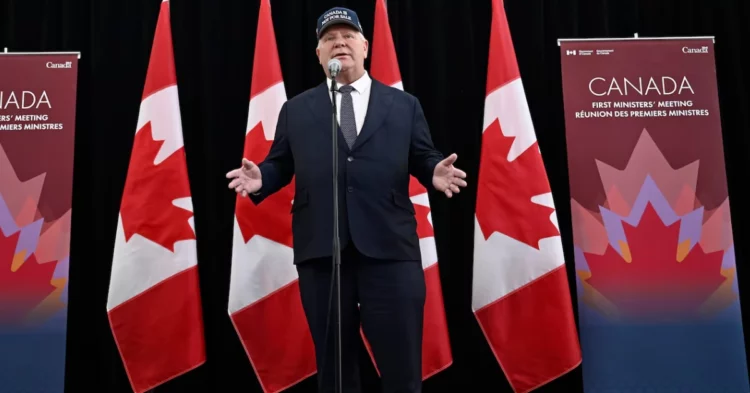
Ontario Premier Doug Ford responded forcefully on X (formerly Twitter), dismissing Trump’s remarks and reaffirming Canadian sovereignty.
He stated:
“I can’t believe I have to say this again, but Canada will never be the 51st state. Canada is not for sale.”
Ford’s message was widely circulated and became one of the most prominent political responses in Canada to Trump’s comments.
Emphasis on Sovereignty and National Identity
Ford’s response reflects a consistent position among Canadian political leaders across party lines: Canada’s sovereignty is non-negotiable. While political leaders may differ on economic strategy, there is broad agreement that the idea of annexation is politically unrealistic and constitutionally impossible.
Ford’s statement also reflects growing sensitivity in Canadian politics toward U.S. rhetoric perceived as undermining national independence.
Political Reactions Across Canada
Mark Carney’s Measured Approach
Prime Minister Mark Carney has taken a more restrained tone. While he has not directly responded to Trump’s latest comments, he has acknowledged economic challenges and emphasized the need for long-term stability.
Carney recently noted that Canada’s economy is experiencing “weakness,” but avoided labeling the situation as a full recession. He has also stressed that structural reforms—including adjustments in immigration and government spending—are part of a broader economic restructuring strategy.
At the same time, Carney has previously made Canada’s position clear, stating that the country “is not for sale and will never be for sale” in earlier diplomatic exchanges.
Broader Political Response
Other political voices in Canada have also weighed in:
- Opposition leaders have criticized the government’s handling of the economy
- Some argue that tariffs and trade uncertainty with the U.S. are worsening conditions
- Others stress domestic policy decisions as contributing factors to the slowdown
The debate has become highly politicized, with interpretations of the recession varying sharply across party lines.
The Role of U.S.-Canada Trade Tensions
Tariffs and Economic Pressure
A key underlying factor in the current tension is ongoing trade friction between the United States and Canada. Tariffs, policy uncertainty, and shifting trade negotiations have created instability for businesses operating across the border.
Canada’s heavy reliance on U.S. trade means that even small policy shifts in Washington can have outsized effects on Canadian growth.
USMCA Uncertainty
The future of the United States-Mexico-Canada Agreement (USMCA) has also added to uncertainty. Negotiations around renewal and long-term stability are ongoing, with Canadian officials pushing for a 16-year extension to reduce unpredictability in trade relations.
(AP News)
Economic Debate: Who Is Responsible for the Slowdown?
External Factors
Some analysts attribute Canada’s slowdown to external pressures, including:
- Global economic uncertainty
- U.S. tariff policy
- Slower investment flows
- Weak global demand in key sectors
These factors are largely outside Canada’s direct control.
Domestic Factors
Others point to domestic policy choices such as:
- Reduced immigration targets affecting labor supply
- Tightened government spending
- Housing market pressures
- Productivity challenges
This mix of causes has made it difficult for policymakers to identify a single source of the downturn.
Ford’s Economic Counterargument: Jobs and Performance
In defending Ontario’s economic performance, Doug Ford highlighted job creation data, claiming that Ontario has outperformed U.S. job growth on a population-adjusted basis in recent months.
He emphasized that Ontario created significantly more jobs relative to its population size compared to the United States, framing the province as a strong economic performer despite national headwinds.
This claim has been used politically to argue that provincial policy in Ontario is helping offset broader economic weakness.
Why Trump’s “51st State” Comments Resonate Politically
Symbolism Over Policy
While widely dismissed in Canada as unrealistic, Trump’s remarks carry symbolic weight. They are often interpreted less as literal proposals and more as rhetorical tools highlighting:
- Trade dependency
- Economic integration
- Political leverage in negotiations
Domestic Canadian Reaction
In Canada, however, the comments tend to trigger strong nationalistic responses, reinforcing political unity around sovereignty issues even during periods of internal disagreement.
Ford’s statement reflects this pattern clearly: regardless of economic conditions, political leaders quickly converge on defending independence.
Conclusion: A Mix of Economics and National Identity
The latest exchange between Doug Ford and Donald Trump illustrates how economic conditions and political rhetoric are increasingly intertwined in North American relations.
On one hand, Canada is grappling with a real economic slowdown marked by technical recession indicators and policy uncertainty. On the other hand, Trump’s provocative comments about Canada becoming the “51st state” have added a symbolic and political dimension to an already sensitive economic moment.
Doug Ford’s firm rejection—“Canada is not for sale”—underscores a consistent national position that transcends party lines. Meanwhile, Prime Minister Mark Carney’s measured response reflects a focus on economic stabilization rather than political confrontation.