Stick to the Facts
Add Nbsla.ca as a Preferred Source on Google to see more of our stories in your search results.

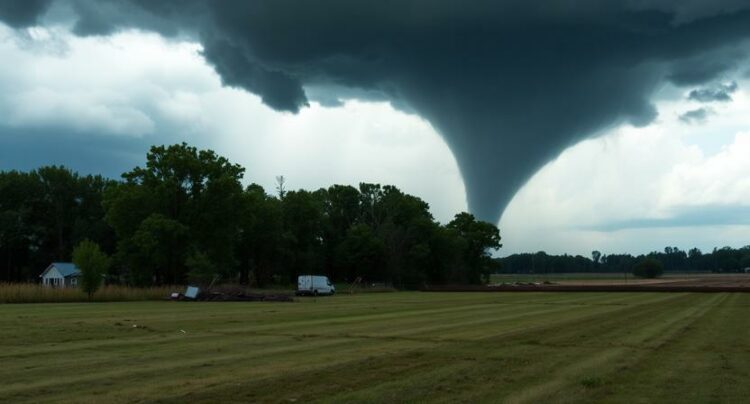
Ontario’s severe weather season has officially begun after meteorologists confirmed Canada’s first tornado of 2026. The storm system that swept across parts of southwestern Ontario on May 9 produced both an EF0 tornado near Granton and an EF0 microburst south of Lucan, according to investigators with the Northern Tornadoes Project.
While the damage was relatively limited compared to stronger tornado outbreaks, the event served as an early-season reminder that dangerous weather can develop quickly across the province during late spring.
Fortunately, no injuries or fatalities were reported.
Tornado Confirmed Near Granton, Ontario
The Northern Tornadoes Project confirmed that an EF0 tornado touched down south of Granton, Ont., during the evening storm on May 9. Investigators conducted both ground and drone surveys the following day to assess the extent of the damage and determine the storm’s strength.
The tornado carried estimated peak wind speeds of 110 km/h, placing it at the lowest level on the Enhanced Fujita Scale. Even weaker tornadoes, however, are capable of causing significant localized destruction.
Among the most notable damage reported was a truck pulling a trailer that was overturned during the storm. Investigators also documented damage to a pedestal-mounted solar panel and several large tree branches snapped or broken across the affected area.
Related: Late-Season Snowstorms Set to Slam Multiple Provinces as Canada Heads Toward Victoria Day Weekend
Tornado Path Likely Extended Beyond One Kilometre
Researchers said the tornado’s exact path remains somewhat uncertain because damage indicators were limited in rural areas. Based on the available evidence, however, the tornado likely tracked for at least one kilometre while moving from west to east.
The brief tornado developed within a larger storm system that moved rapidly through the region during the evening hours.
Although EF0 tornadoes are considered weak compared to violent tornadoes that can level neighborhoods, they still pose serious risks to anyone caught outdoors or travelling during severe weather.
Powerful Microburst Also Struck Near Lucan
The same storm system also generated an EF0 microburst south of Lucan, another small Ontario community located northwest of London.
Unlike a tornado, which involves rotating winds, a microburst is a concentrated column of rapidly descending air that spreads outward upon hitting the ground. These events can produce intense straight-line winds capable of causing destruction similar to weaker tornadoes.
In this case, the microburst produced estimated maximum wind speeds of 130 km/h.
The most significant damage involved a farm building that lost its roof during the violent burst of wind. Debris was scattered across the property as the storm passed through the area.
Meteorologists noted that the start time of the event was estimated using radar data, while satellite imagery reviews remain ongoing as part of the investigation.
What Is an EF0 Tornado?
The Enhanced Fujita Scale is used across North America to classify tornado intensity based on estimated wind speeds and observed damage.
An EF0 tornado is the weakest category on the scale, with wind speeds ranging from 105 km/h to 137 km/h.
Despite being considered “weak,” EF0 tornadoes can still:
- Damage roofs and siding
- Snap tree branches
- Overturn lightweight vehicles or trailers
- Toss debris through the air
- Damage power infrastructure and solar equipment
Most tornadoes in Canada fall within the EF0 to EF2 range, though stronger tornadoes occasionally occur during major severe weather outbreaks.
Ontario Enters Peak Severe Weather Season
Meteorologists say May and June are historically among the most active months for severe weather across Ontario.
Warm, humid air moving northward from the United States often collides with cooler Canadian air masses during spring, creating ideal conditions for thunderstorms capable of producing:
- Tornadoes
- Large hail
- Damaging winds
- Flash flooding
- Frequent lightning
Southern Ontario is particularly vulnerable because of its geography and proximity to the Great Lakes, which can help intensify storm systems under the right atmospheric conditions.
Communities stretching from Windsor through London, Kitchener, Barrie, Ottawa, and eastern Ontario frequently experience severe thunderstorm watches and tornado warnings during late spring and summer.
Canada’s Tornado Season Is Beginning Earlier Again
Canada typically sees its first tornadoes of the year between April and May, though the timing varies depending on weather patterns and temperatures.
Experts say warmer spring conditions and increasingly volatile weather patterns have contributed to earlier and more active severe weather seasons in recent years.
The confirmation of both a tornado and a microburst this early in May signals that Canadians should begin preparing now for potentially active summer weather across parts of Ontario and the Prairies.
Emergency officials continue urging residents to:
Stay Alert During Severe Thunderstorm Watches
Conditions can change quickly during spring and summer storms. Watches indicate that severe weather is possible, while warnings mean dangerous weather is occurring or imminent.
Have Multiple Ways to Receive Alerts
Weather radios, smartphone notifications, and local alerts can provide life-saving information during fast-moving storms, especially overnight.
Prepare an Emergency Plan
Families should know where to shelter during tornado warnings, ideally in a basement or an interior room away from windows.
No Injuries Reported After Ontario Storms
Despite the damage caused by both the tornado and microburst, officials confirmed that no injuries were reported during either event.
Damage surveys and satellite reviews are expected to continue as meteorologists gather additional information about the storms that marked the beginning of Canada’s 2026 tornado season.