Stick to the Facts
Add Nbsla.ca as a Preferred Source on Google to see more of our stories in your search results.

For many travelers, flying in economy class is often a compromise between affordability and comfort. While low fares can make travel accessible, the experience of spending several hours in a cramped seat with limited legroom can quickly turn an exciting journey into an uncomfortable ordeal. This is especially true on long-haul flights, where passengers may spend eight, ten, or even fifteen hours seated in the same position.
Among the many factors that influence passenger comfort, seat pitch—commonly referred to as legroom—remains one of the most important. Even a difference of one or two inches can significantly impact how comfortable travelers feel during a flight. While many airlines have reduced seat spacing over the years to accommodate more passengers, a select group of carriers continues to prioritize comfort by offering more generous seating arrangements.
Leading the industry are Japan Airlines (JAL) and All Nippon Airways (ANA), both of which have built reputations for providing some of the most spacious economy cabins in commercial aviation. Other airlines, including Emirates, JetBlue, Singapore Airlines, Cathay Pacific, and Qantas, also offer above-average legroom that helps make long journeys more enjoyable.
This guide explores the airlines that provide the most legroom in economy class and examines why some carriers continue to prioritize passenger comfort while others focus on maximizing seat capacity.
Why Legroom Matters More Than Ever in Economy Class
Air travel has become more affordable than at any other time in history. Millions of passengers can now travel internationally for a fraction of what similar trips cost decades ago. However, one of the trade-offs for lower fares has been the gradual reduction of personal space in economy cabins.
Seat pitch measures the distance from a point on one seat to the same point on the seat directly in front. While this measurement does not represent actual usable legroom, it serves as the industry standard for comparing seating comfort.
Most major airlines today offer economy-class seat pitch ranging from 30 to 32 inches. Budget carriers often reduce that figure even further, with some offering as little as 28 inches.
For taller travelers or passengers taking long flights, these reductions can have a noticeable impact. Limited space can contribute to discomfort, restricted movement, poor sleep quality, and increased fatigue upon arrival.
As a result, airlines that maintain generous seat pitch often stand out among frequent travelers seeking a more comfortable experience.
Japan Airlines and ANA Set the Global Standard for Economy Comfort
When discussing economy-class comfort, two airlines consistently dominate the conversation: Japan Airlines and All Nippon Airways.
Both carriers offer approximately 34 inches of seat pitch across much of their long-haul fleets, making them among the most spacious airlines in the world for economy travelers.
Japan Airlines’ Sky Wider Philosophy
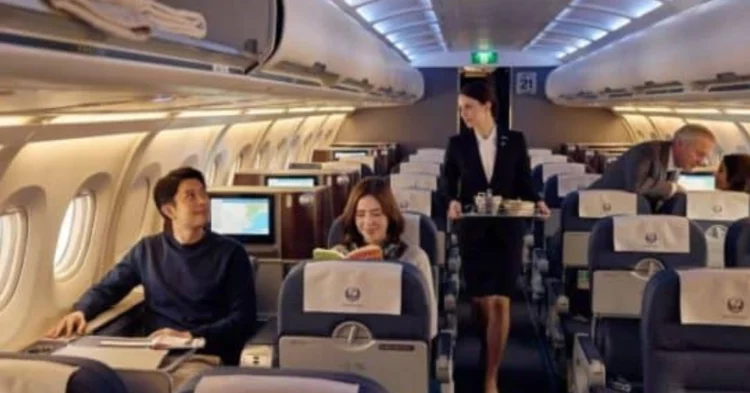
Japan Airlines has earned widespread recognition for refusing to follow the industry trend of aggressively increasing seat density.
The airline introduced its innovative “Sky Wider” economy concept, designed specifically to improve passenger comfort without sacrificing efficiency.
One of the most notable examples is found on JAL’s Boeing 787 Dreamliner fleet. While many airlines configure the aircraft with nine seats per row in a 3-3-3 arrangement, Japan Airlines uses a roomier 2-4-2 configuration.
This layout allows passengers to enjoy wider seats, greater personal space, and a more comfortable cabin environment.
Beyond seat configuration, JAL utilizes slim seat-back technology that increases knee clearance while maintaining comfortable cushioning. The result is an economy-class experience that feels even more spacious than the official seat pitch measurements suggest.
ANA’s Commitment to Passenger Comfort
All Nippon Airways follows a similar philosophy.
As Japan’s largest airline and JAL’s primary domestic competitor, ANA has long emphasized service quality and passenger satisfaction.
Its long-haul Boeing 777-300ER and Boeing 787-9 fleets generally feature 34 inches of seat pitch, providing travelers with exceptional comfort on international routes.
The airline is also investing heavily in future cabin improvements. Beginning in 2026, ANA plans to introduce new Recaro economy seats on select Boeing 787-9 aircraft.
These seats will provide additional knee room while significantly increasing recline capability. The redesigned seating system will offer approximately seven inches of recline, among the most generous available in economy class worldwide.
For passengers spending extended periods in the air, these enhancements can make a substantial difference.
Economy Class Legroom Rankings: Airlines Offering the Most Space
While Japanese airlines lead the rankings, several other international carriers continue to provide above-average legroom for economy passengers.
1. Japan Airlines
Legroom: 34 inches (86.4 cm)
Japan Airlines consistently ranks among the world’s most comfortable airlines thanks to its spacious seating, innovative cabin design, and commitment to customer comfort.
2. All Nippon Airways
Legroom: 34 inches (86.4 cm)
ANA matches JAL’s generous seating standards and combines them with exceptional service and modern cabin amenities.
3. Emirates
Legroom: 34 inches (86.4 cm)
Passengers flying on Emirates’ Airbus A380 fleet enjoy some of the most spacious economy seating available, complemented by industry-leading entertainment systems and premium service.
4. JetBlue Airways
Legroom: 32.3 inches (82.0 cm)
JetBlue offers the most legroom among major U.S. airlines and has built its brand around providing a more comfortable economy experience.
5. Cathay Pacific
Legroom: 32 inches (81.3 cm)
The Hong Kong-based carrier remains one of Asia’s strongest economy-class products thanks to its balance of comfort, service, and reliability.
6. Singapore Airlines
Legroom: 32 inches (81.3 cm)
Known worldwide for excellence, Singapore Airlines combines spacious seating with outstanding onboard service.
7. Qantas
Legroom: 32 inches (81.3 cm)
Australia’s flag carrier continues to provide competitive comfort levels across its long-haul network.
8. Southwest Airlines
Legroom: 31.8 inches (80.8 cm)
Southwest offers slightly more room than many domestic competitors while maintaining its reputation for affordable travel.
9. Alaska Airlines
Legroom: 31 inches (78.7 cm)
Alaska balances comfort and value while earning strong customer satisfaction ratings.
10. Delta Air Lines
Legroom: 31 inches (78.7 cm)
Delta remains one of America’s most respected carriers and provides competitive seating compared to many rivals.
Why Airlines Continue to Reduce Economy-Class Space
Despite frequent passenger complaints about cramped seating, airlines continue to shrink economy cabins.
The reason is simple: economics.
Even a seemingly small reduction in seat pitch can generate substantial revenue.
The Financial Impact of One Extra Row
Reducing seat pitch by just one inch can allow airlines to install additional rows of seats on an aircraft.
For a narrow-body jet operating hundreds of flights annually, the additional seats can produce millions of dollars in extra revenue.
When multiplied across an entire fleet, the financial benefits become enormous.
This is why many airlines have chosen to prioritize capacity over comfort.
Competition From Low-Cost Carriers
The rise of ultra-low-cost airlines has intensified pressure on traditional carriers.
Companies such as Ryanair and other budget operators often offer extremely low fares by maximizing seat density and minimizing operating costs.
To remain competitive, many full-service airlines have adopted similar strategies in economy class.
While passengers frequently express dissatisfaction with reduced legroom, purchasing behavior often tells a different story. Most travelers still choose lower fares over increased comfort when comparing ticket prices.
The Rise of Modern Slimline Seats
Aircraft seat manufacturers have developed new technologies to address shrinking cabin space.
Modern slimline seats use thinner materials, advanced composites, and redesigned structures to create a greater sense of openness.
How Slim Seats Create More Space
Traditional aircraft seats featured thick cushions and bulky frames that occupied valuable cabin space.
Newer designs eliminate unnecessary bulk while maintaining comfort standards.
Manufacturers argue that a modern 31-inch seat pitch can feel similar to an older 34-inch configuration because passengers gain additional knee clearance from thinner seat backs.
Although some travelers remain skeptical, these innovations have become increasingly common across the industry.
Why Japanese Airlines Can Afford to Offer More Legroom
One of the biggest questions in aviation is why Japanese airlines continue to provide generous economy seating while many competitors have reduced space.
The answer involves culture, business strategy, and market positioning.
The Influence of Omotenashi
Japanese hospitality is deeply rooted in the concept of “Omotenashi,” a philosophy centered on anticipating customer needs and delivering exceptional service.
This mindset extends beyond cabin crew interactions and influences every aspect of the travel experience, including seat comfort, cabin design, and passenger amenities.
For airlines like JAL and ANA, maintaining a superior economy product strengthens brand reputation and customer loyalty.
A Premium-Focused Business Model
Rather than competing solely on ticket prices, Japanese airlines emphasize quality and passenger satisfaction.
Their strategy focuses on maximizing revenue per seat through service excellence rather than maximizing passenger numbers through dense seating arrangements.
This approach allows them to maintain spacious cabins while preserving profitability.
JetBlue’s Unique Position in the U.S. Market
Among American airlines, JetBlue stands apart for its commitment to passenger comfort.
While many domestic competitors have reduced seat pitch to increase capacity, JetBlue has deliberately chosen a different path.
More Legroom as a Competitive Advantage
JetBlue uses comfort as a major selling point.
Its Airbus A320 and A321 fleets generally feature fewer rows than competing airlines, allowing for more generous spacing throughout the cabin.
Passengers benefit from seat pitches ranging from approximately 32 to 34 inches, significantly above the industry average.
Additional Comfort Features
Beyond legroom, JetBlue offers several amenities that enhance the economy experience.
These include:
Free high-speed Wi-Fi
Seatback entertainment screens
Complimentary snacks and beverages
Modern cabin interiors
These features help distinguish JetBlue from competitors in one of the world’s most competitive aviation markets.
Airlines That Balance Comfort and Efficiency
Several global airlines occupy a middle ground between maximum comfort and maximum capacity.
Singapore Airlines
Singapore Airlines has long been considered one of the world’s premier carriers. Although its economy seating is slightly denser than JAL or ANA, the airline compensates with exceptional service and high-quality onboard amenities.
Cathay Pacific
Cathay Pacific continues to maintain strong standards despite industry-wide pressure to increase density. Passengers benefit from comfortable seating and attentive service on long-haul routes.
Qantas
Australia’s national carrier provides a reliable economy experience and remains popular among travelers on long-distance international flights.
Emirates
Emirates stands out for combining generous legroom with luxury-inspired service, particularly on its Airbus A380 fleet. The airline’s entertainment system is frequently ranked among the best in the world.
What Travelers Should Consider Beyond Legroom
While seat pitch is important, it is not the only factor that determines comfort.
Passengers should also evaluate:
Seat width
Recline range
Cabin layout
Entertainment options
Wi-Fi availability
Meal quality
Crew service
Aircraft type
An airline offering slightly less legroom may still provide a superior overall experience when these additional factors are considered.
The Future of Economy-Class Comfort
The debate between comfort and profitability is likely to continue shaping airline cabins for years to come.
Most carriers face intense pressure to maximize revenue and keep fares competitive. As a result, significant increases in seat pitch across the industry appear unlikely.
However, airlines that prioritize customer experience continue to prove there is demand for comfortable economy travel.