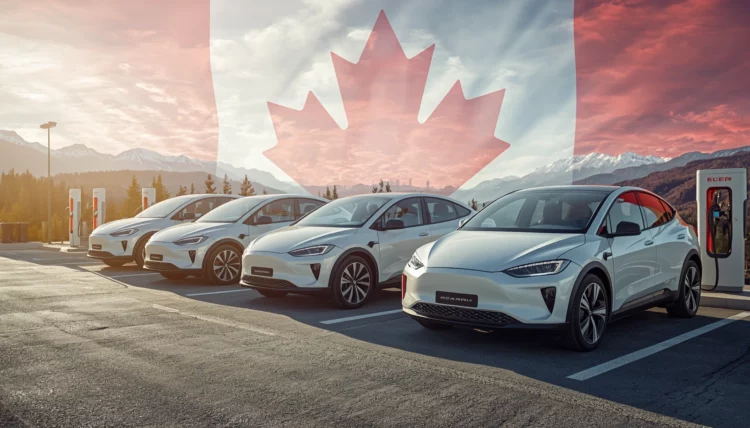
Stick to the Facts
Add Nbsla.ca as a Preferred Source on Google to see more of our stories in your search results.

Canada’s transition to cleaner transportation is gaining serious momentum. New data shows a sharp surge in zero-emission vehicle (ZEV) sales, driven largely by the return of federal incentives and rising fuel costs. As programs from Transport Canada take effect, more Canadians are rethinking how they drive and what they pay at the pump.
ZEV Sales Surge Despite Overall Market Dip
According to the latest report released by Transport Canada, total new vehicle sales in February 2026 reached 124,004 units. That represents a slight 0.9% decline compared to the same month last year.
Breaking it down further:
- Passenger car sales dropped by 3.8%
- Truck sales declined slightly by 0.5%
But while the broader auto market slowed, the ZEV segment told a completely different story.
A total of 12,626 zero-emission vehicles were sold in February alone. That marks:
- A 47.2% increase year-over-year
- A 45.6% jump compared to January
This sharp growth highlights how quickly Canadians are shifting toward electric options, and other rising transportation costs continue to affect household budgets.
ZEV Market Share Crosses 10% Milestone
The surge in sales has pushed ZEVs to account for 10.2% of all new vehicle sales in Canada. Just a year ago, that figure stood at 6.9%.
This category includes:
- Battery Electric Vehicles (BEVs)
- Plug-in Hybrid Electric Vehicles (PHEVs)
Together, these vehicles are capturing a growing share of the market as more drivers look to avoid fluctuating fuel prices indirectly impact everyday expenses.
Federal $5,000 Rebate Sparks Immediate Demand
A major factor behind this surge is the reintroduction of federal incentives through the Electric Vehicle Affordability Program.
Launched on February 16, 2026, the program offers:
- Up to $5,000 for battery electric vehicles
- Up to $2,500 for plug-in hybrid vehicles
Even though the program was only active for part of February, the impact was immediate. January sales were relatively low at 8,672 units, suggesting many buyers delayed purchases in anticipation of the rebate.
Once the program returned, demand quickly rebounded, showing how sensitive the market is to financial incentives.
For many households already dealing with rising logistics costs, the rebate provides a timely financial cushion that makes EV ownership more accessible.
Why Fuel Costs Are Driving the Shift
Fuel prices remain one of the biggest motivators behind the switch to electric vehicles. As gasoline costs fluctuate and delivery-related expenses continue to rise, consumers are looking for more predictable alternatives.
Electric vehicles offer:
- Lower operating costs
- Reduced reliance on fuel markets
- Potential savings over the long term
The connection is becoming clearer. As fuel-related expenses increase across the economy, from personal driving to shipping and delivery, demand for ZEVs continues to grow.
EV Interest Surges in Canada as Gas Prices Climb and Rebates Return
Program Stability Through 2031 Supports Long-Term Growth
The Electric Vehicle Affordability Program is set to remain in place through 2031, although incentive amounts will gradually decline over time.
This long-term structure provides:
- Predictability for buyers
- Confidence for automakers
- A stable policy environment for EV adoption
With incentives locked in for several years, Canadians can plan their purchases without worrying about sudden policy changes.
Combined with ongoing economic pressures, this stability is expected to further accelerate the shift toward zero-emission vehicles.
Stronger Growth Expected in Spring Data
Since the rebate was only available for part of February, the full impact is likely to show in upcoming months.
March and April data are expected to reflect:
- Higher total ZEV sales
- Increased market share
- Continued consumer demand
With the rebate now fully available and fuel costs still a concern, momentum is building.
The continued presence of cost pressures will likely reinforce consumer behavior, pushing even more buyers toward electric vehicles.
Still Below Record Highs, But Momentum Is Building
Despite the impressive growth, current ZEV sales are still below peak levels.
In September 2024, Canada recorded an all-time high of over 30,000 ZEV units sold in a single month.
This means:
- The market has room to grow
- Current gains represent recovery and expansion
- Future records are possible if trends continue
With supportive policies and rising cost pressures the conditions are in place for another surge.
The Bigger Picture: Canada’s Transition to Electric Mobility
Canada’s push toward zero-emission transportation is part of a broader national strategy to reduce emissions and modernize infrastructure.
Programs led by Transport Canada aim to:
- Increase EV adoption nationwide
- Reduce greenhouse gas emissions
- Support clean energy innovation
The rapid growth in ZEV sales shows that policy measures are working, especially when combined with real-world economic factors like fuel costs.
What This Means for Canadian Drivers
For everyday Canadians, the shift toward electric vehicles is becoming less of a future concept and more of a present reality.
Key takeaways:
- Federal rebates are back and making an immediate impact
- ZEV sales are rising quickly despite overall market slowdown
- Fuel-related costs, including the amazon canada fuel surcharge, are influencing buying decisions
- Long-term incentives provide stability for future purchases
Canada’s ZEV market is entering a new phase of growth. The return of federal rebates, combined with ongoing cost pressures like the amazon canada fuel surcharge, is accelerating the transition toward electric vehicles.
While the market has not yet reached its previous peak, the current trajectory suggests that stronger growth is ahead. With incentives in place through 2031 and consumer demand rising, zero-emission vehicles are set to play an increasingly central role in Canada’s automotive future.