Stick to the Facts
Add Nbsla.ca as a Preferred Source on Google to see more of our stories in your search results.

For the first time in more than 25 years, signs of the legendary giant squid have reappeared in Western Australian waters, astonishing marine researchers and reigniting fascination with one of the ocean’s most mysterious creatures. But the rediscovery is only one part of a much larger scientific breakthrough that is transforming our understanding of the deep Indian Ocean.
Using advanced environmental DNA technology, scientists uncovered traces of the elusive giant squid hidden within deep submarine canyons near the Nyinggulu, or Ningaloo, coast. The findings emerged during a major biodiversity survey that revealed hundreds of marine species thriving in one of the least explored regions on Earth.
The study has not only confirmed the northernmost known presence of the giant squid in the eastern Indian Ocean, but also uncovered rare animals, previously undocumented marine life, and ecosystems scientists barely understood until now.
Giant Squid Detected After Decades of Silence
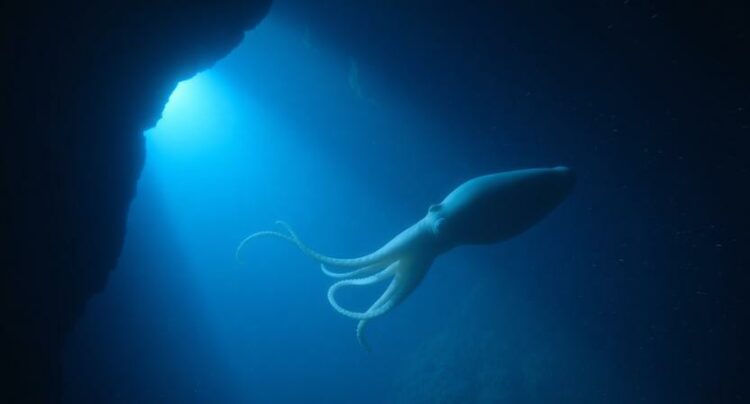
The giant squid, known scientifically as Architeuthis dux, has long occupied a near-mythical place in marine science. Growing longer than a school bus and weighing as much as 275 kilograms, the enormous cephalopod possesses the largest eyes ever recorded in the animal kingdom.
Despite its massive size, encounters with giant squid remain extremely rare because the species inhabits remote deep-sea environments thousands of metres beneath the ocean’s surface.
Researchers detected the squid through environmental DNA, often called eDNA, which captures microscopic genetic traces animals leave behind in seawater. Scientists discovered giant squid DNA in six separate samples collected from two deep submarine canyons off the Western Australian coast.
The discovery marks the first time giant squid presence has been confirmed in the region using eDNA methods. It is also the first verified evidence of the species in these waters in over a quarter of a century.
A Massive Deep-Sea Expedition Beneath the Indian Ocean
The groundbreaking survey was led by researchers from Curtin University and later published in the journal Environmental DNA. Scientists conducted the mission aboard the Schmidt Ocean Institute’s research vessel Falkor, exploring the Cape Range and Cloates submarine canyons.
These underwater canyons plunge more than 4,500 metres below the ocean surface and sit roughly 1,200 kilometres north of Perth. Much of the region had remained scientifically unexplored due to the difficulty and expense of studying such extreme depths.
During the expedition, researchers gathered more than 1,000 water samples from different ocean layers throughout the canyons. The samples allowed scientists to map marine biodiversity on an unprecedented scale without physically capturing the animals themselves.
Hundreds of Species Found in Hidden Ocean Ecosystems
The survey revealed an extraordinary level of biodiversity lurking in the deep ocean. Scientists identified 226 species spanning 11 major animal groups, including deep-sea fish, marine mammals, echinoderms, cnidarians, and cephalopods.
Among the discoveries were several rare species never before recorded in Western Australian waters.
Rare Deep-Sea Creatures Identified
Researchers detected unusual and elusive animals including:
Sleeper Shark
The mysterious sleeper shark, classified as Somniosus species, is known for inhabiting deep and cold waters. Very little is understood about its behaviour or population size in Australian waters.
Faceless Cusk Eel
The bizarre faceless cusk eel, Typhlonus nasus, stunned researchers once again with its unusual appearance. The species lacks visible eyes and external facial features, making it one of the strangest fish ever documented.
Slender Snaggletooth
Another surprising discovery was the slender snaggletooth, Rhadinesthes decimus, a rarely observed deep-sea predator adapted to life in darkness.
Deep-Diving Marine Mammals
Scientists also found evidence of deep-diving whales, including the pygmy sperm whale and Cuvier’s beaked whale, both known for their ability to descend to extraordinary depths in search of food.
Scientists Believe Many Species May Still Be Unknown
One of the most exciting outcomes of the research was the large number of genetic sequences that failed to match known species records.
Lead researcher Dr Georgia Nester explained that many organisms detected in the survey do not neatly align with anything currently catalogued in scientific databases. While that does not automatically confirm entirely new species, it strongly suggests that large portions of deep-sea biodiversity remain undiscovered.
The findings highlight how little scientists still know about life in the deep Indian Ocean, despite decades of marine exploration around the world.
How Environmental DNA Is Changing Ocean Science
Environmental DNA technology is rapidly becoming one of the most important tools in marine biology.
Every marine animal constantly sheds genetic material into the surrounding environment through skin cells, mucus, waste, and other biological traces. By collecting seawater samples and analysing these microscopic fragments, scientists can determine which species are present in a region without directly observing them.
Why eDNA Is So Powerful
Traditional deep-sea exploration methods often rely on cameras, trawling equipment, or expensive submersibles. These approaches can miss elusive animals or disturb fragile ecosystems.
Environmental DNA offers a faster and far less invasive alternative. A single sample of seawater can reveal hundreds of species at once, providing scientists with a far broader understanding of marine ecosystems.
Researchers say the technique is especially valuable in deep-ocean environments where visibility is poor and physical exploration is difficult.
Different Ocean Depths Support Entirely Different Worlds
The study also uncovered another major scientific revelation. Biodiversity within the submarine canyons was not evenly distributed.
Scientists found that different depth zones hosted completely different ecological communities. Even neighbouring canyons located close together supported distinct populations of marine life.
Vertical Layers of Ocean Life
The research revealed a remarkable vertical stratification of species across more than four kilometres of ocean depth. Certain animals occupied only specific layers of the water column, creating stacked ecosystems stretching from the surface to the abyss.
This discovery provides new insight into how deep-sea environments function and how marine species adapt to varying pressure, temperature, and food availability.
Why the Findings Matter for Conservation
Marine scientists warn that deep-sea ecosystems face growing threats from climate change, commercial fishing, and potential resource extraction projects such as deep-sea mining.
Until now, researchers lacked baseline biodiversity information for these submarine canyons because the region had rarely been explored.
The new data could now play a critical role in shaping future marine conservation strategies.
Building Better Marine Protection Plans
By understanding which species inhabit these remote environments, conservationists can improve marine park planning and environmental impact assessments. The findings also create a scientific baseline that will help researchers track ecosystem changes in the years ahead.
Scientists say protecting deep-ocean habitats becomes nearly impossible without first understanding what lives there.
Giant Squid Discovery Captures Public Imagination
Although the survey uncovered hundreds of important scientific findings, the giant squid detection has naturally captured global attention.
For generations, giant squid have inspired myths, legends, and fascination because sightings are so exceptionally rare. Confirming the species still moves through Western Australian waters after decades without evidence has reignited excitement surrounding deep-sea exploration.
Researchers believe the discovery serves as a reminder that vast regions of Earth’s oceans remain largely unknown.
The Deep Ocean Still Holds Countless Secrets
The survey off Western Australia demonstrates how modern technology is opening new windows into hidden underwater worlds. Scientists now believe countless species may still await discovery in the Indian Ocean’s unexplored depths.
As environmental DNA research expands, marine biologists expect even more astonishing discoveries in places previously considered unreachable.
For now, the return of the giant squid stands as both a scientific milestone and a powerful symbol of how much mystery still exists beneath the ocean surface.